Tuesday, August 25, 2009

Heading North ...

Saturday, January 10th


At the conclusion of that week, Mandy and I joined six others in a heavily laden van for the return trip up-country.  With every spare space in the van taken up with accompanying luggage and with a heavily laden trailer in tow, we made our happy way back across the Limpopo River and northwards into Zimbabwe.  It seems so simple and straightforward in the telling … but it wasn’t.  Arrival and inch-by-inch progress from the southern to northern banks of the Limpopo River is for the traveler like a sticky, clinging swamp to a cross-country runner.  

Police road-blocks were a further impediment to progress, with an order from a uniformed officer at one resulting in our having to detour to the local Police base to undertake repair of the lights on the trailer we were towing.  With a bulb taken from its intended place at the tail of the trailer, and with a length of wire scrounged from the police camp, we fashioned a crude test light and set about trying to make sense of the tangle of wires intended to carry current from plug to bulbs.

Once clearance was eventually given for us to proceed, we had to undertake the last 175 kilometers (109 miles) of our trip in the dark. 

Driving after dark on Zimbabwean roads is very dangerous for relatively small vehicles.  Large transport lorries tend to travel at this time, paying little attention to potholes that do significant damage to smaller vehicles, sometimes with fatal results.  The metal carnage strewn every few kilometers along the sides of the road had been a persistently graphic reminder of this.  When driving slowly, it is possible even after dark to swerve around the more menacing potholes. That is, unless the blazing lights and considerable bulk of a speeding on-coming lorry, blind the driver’s vision and force one’s vehicles to the edge of the opposing lane.

Shortly after having embarked on this last leg of the trip, the atmosphere inside the van was shattered by a load bang, and accompanying sudden jolt, followed by violent swerving as the driver fought courageously to keep the vehicle and trailer under control.  Once our ensemble had come to a standstill, both vehicle and trailer were as far off the road as the narrow verge would allow.  With the wheels on one side sitting on the surface of the road and the wheels of the other on the considerably eroded soil of the road verge, we disembarked to assess the damage.  Miraculously, our driver had managed to evade the pothole with the front wheel.  Had he not managed to do this we would not be present to tell the tale.  As it was, the rear tyre and rim of the van and tyre and rim of the trailer were destroyed. 

The minimal availability of equipment was made more menacing by the dangerous angle of the vehicle looming over us as we worked to correct the situation.  


As the women prayed, the men worked.  At one point, a jack slipped just after one of our number had removed a vital part of his anatomy from underneath the loaded vehicle.  Eventually, though, we pulled back onto the dangerously pockmarked road to continue on our way.  What should have taken an hour and a half took us over four hours as our intrepid driver nursed the vehicle and trailer homeward, finally arriving at our destination at 11:00 that night.  With a 7:00AM departure that morning, it had turned out to be a very long day. 

Mandy recalls, “As we prayed in the van, it was incredibly comforting to know that many loved ones around the world were covering us and our trip in prayer.  There’s no doubt that God had His hand on our vehicle and fellow travelers that day.”  

Monday, August 24, 2009

Celebration Sunday ...


Sunday, January 11th


The next morning came with a rush and, being Sunday, we found ourselves on the way to a celebration service hosted by the Evangelical Church of Zimbabwe.  The purpose of the exercise was to give opportunity to the twelve hundred or so people who had gathered to rejoice over the reconciliation that had taken place between the church and the mission that had birthed it.

The organizers had given careful thought and done a great deal of work in preparation for the occasion.  A large bowser of clean water, standing near a large open-sided white tent, offered mute evidence of the presence of cholera in the country.  

The atmosphere in the tent as we arrived was less mute, but was just as loud in profound evidence of a heightened level of excitement and anticipation.

Words cannot describe the joy of that morning and lunch hour that followed.  No cultural or historical barrier could come near to preventing the outpouring of love and joy that was expressed and received by all the parties in attendance.  That day, which was without doubt one of the highlights of the whole two months, was made even more special in as much as Wilf Strom … now retired and living in Canada … was there as guest of honour for the occasion.  Wilf and his wife had arrived in the country to serve as missionaries some fifty years previous.  Wilf had eventually held the position of area leader during a very challenging time.  As Field Chairman, he had led the then missionary band through the stormy relational and organizational waters of post-independence tensions that crept into the relationship of mission and church.  This he had done with dignity and Godly grace.  Now, he was present to witness the full-circle evidence of the working of that Godly grace in the lives of all involved.

Mandy commented on the day; "The timing of this amazing celebration; the opportunity to be re-united with many dear friends; the emotion of the occasion, all worked together to open the floodgates of long dammed up emotion for me. It was difficult to take pictures of the event through the flowing tears! Praise the Lord for His goodness and graciousness!"

Sunday, August 23, 2009

A local Interlude ...


Tuesday, January 13th  

After a day of rest, and a lovely dinner at the home of one of the missionaries, Tuesday’s dawn ushered us into a round of visiting key installations and individuals around the city.  We visited Harare Theological College and saw the good work of training being accomplished there. 
At this point Mandy was excused from the group trips for the rest of the week and was able to join precious friends on their farm in the northeast of the country. They are numbered among the very few who are still on their farm, and despite seemingly insurmountable odds are still managing to eek out an existence.

Mandy wrote, "During my time with them I was given yet another window from another perspective to look through. My heart ached again as I learned of the incredibly stressful challenges they live with:
 * the deep concern for their daughter, a young mother, whose pulse is alarmingly slow and who needed to travel to South Africa to have a pace maker inserted.
* the torrid times of having their farm invaded or interfered with.
* dealing with a workforce who are unable to source their own food supplies due to the empty shelves in the supermarkets; workers who are HIV positive and increasingly unable to put in a full day’s work; workers who need time off on a regular basis to bury family members who have succumbed to the ravages of Aids or any one of a number of diseases that over-power their weakened or non existent immune systems; workers who need medical attention from barely functioning clinics or hospitals that have no medical supplies.
* the pleas for expertise and practical help from those who have taken and occupied large tracts of your land with the full support of the judicial system and law makers.
* struggling to keep old and tired farm machinery and vehicles functioning despite the outrageous cost of spare parts IF they can be found.
* remaining viable when the infrastructure of the country is crumbling: bad roads, unreliable telephone service, electricity cuts, spiraling inflation, worthless bank notes, crime and corruption at every level.


It was my joy to observe their rock solid faith and trust in the Lord despite everything, and to pray with and for them. I was given the great privilege of visiting others in the district living under the same circumstances, hearing their hearts, and praying with them too."

Saturday, August 22, 2009

Excursion to Kapfundi ...

Wednesday, January 14th 


Early Wednesday morning, a contingent of Evangelical Church leaders joined our group to travel in a convoy of two vehicles out past Karoi to the site of an old mission station, now a scattered ruin of debilitated and destroyed buildings, where a school was begun, a Bible college established, a clinic built … and a church given birth.

A small clinic, struggling to operate without running water and adequate amounts of necessary drugs and materials represented the only evidence of resuscitation.  The congregation of people who gathered for an impromptu four-hour long service was the only evidence of what had survived the passage of the years and socio-economic ravages afflicting the nation in the previous three decades.

Returning to the mission station site brought back a flood of memories for those of us in our group who had lived there.

This was particularly true for Wilf Strom, a veteran missionary traveling with us, who saw the remains of the house he and his family had lived in and looked for the spot where he and his wife had laid one of their infant children to rest.    


Excursion to Mt Darwin District ...

Thursday, January 15th


The trip out into the Mt Darwin district the following day was a particularly poignant one for me, as I had lived in the region for a special part of my childhood, then lived and worked there as a married man with a young wife and two small children. 

Even before we had found opportunity to sit and speak with the people in their villages, we noticed profound evidence of decay.  The extremes we had observed the day before in the Urungwe tribal area were equally apparent as we traveled into Chief Chiweshe’s realm.  Nation-wide scarcity of something as basic as bicycle inner tubes and patches and compound glue was evident by the conspicuous absence of bicycles, perennially abundant modes  of haulage and transportation that had been such a common fixture in previous years.


In spite of abundant rains, the crops were very poor if evident at all.  Previously available small subsidized packets of registered and treated maize seed had been absent for some time, as was the case with Compound ‘D’ fertilizer, traditionally applied at planting and, later, the fondly referred to “A.N.” (ammonium nitrate) widely used as a top dressing for the established plants.
  

Once plentiful chickens, goats and cattle were very few and far between.  Domesticated guinea fowl had become a common addition to the few scrawny chickens that still scratched around the villages.  At one point, we encountered a pair of forlorn looking muscovy ducks wandering aimlessly along the dirt road.

On the way to Karanda Hospital, we called in at what had been Chironga mission station.  The now government-controlled school classrooms that the missionaries had built still stood there, as did the structure that had once housed the teacher training school.  Many of the missionary houses remained, lived in by government teachers and their families.

The burial site of a missionary couple’s infant boy, and another’s grown son, was still there where I remembered it to be; wrapped in the verdant embrace of the rainy season, tucked in behind the protective bulk of a granite outcrop.

After having reached our destination, we established our temporary residence at Karanda Hospital’s lovely guesthouse.  Personal nostalgia continued for me as I made my way toward the house where my family and I had lived when we first arrived there as missionaries twenty eight years previously.

I further celebrated my return just before dark, as I made my way to the village of the aged Baba Josiah.  He had once been the tractor driver at the hospital station, and kind friend of our small children.  I had met his son, Solomon one afternoon as I hunted for guinea fowl along the Ruya river.  That was the beginning of a friendship that had stood the test of time and shifting circumstances.


I’ll take the liberty of digressing here, to tell you the story.

I first saw Solomon sitting in a dry sandy portion of the riverbed that afternoon.  He was sitting on a large granite boulder worn smooth by the unrelenting flow of water in that cycle in the life of the river each year when the river ran full and strong. Customary greetings were exchanged, and I sat with Solomon on that rock as we heard of one another’s families, exchanged thoughts on local issues and began to gain a measure each of the other.

As the afternoon turned to evening, we negotiated our way out of the river bed through the wafted aroma of wild herbs that grew on the bank of the river, and up in the direction of his village. At one point, once we were in the vicinity of the community fields of maize stubble, we stepped off the path to make our way through the dry golden left-overs of the year’s crop to where we found a ripe watermelon on the vine.  Making ourselves comfortable in the dry maize litter, we shared that watermelon and began to find out more about one another.  It was there, and in the ensuing days that Solomon’s personal story emerged.

At the age of twelve, he had left home early one morning as he had done every other morning of the school year.  Bare foot and dressed in khaki shirt and shorts he joined his friends to walk, rulers and pencils in hand, to the school he attended.  That day, the whole school was visited by guerilla combatants, every child abducted and taken on a force march that lasted many days.  The column made their way north toward the Zambezi Valley and the river that gave it its name.   In the course of the journey, a number of children died of thirst and exposure.  On one occasion, some were killed in the cross fire of a running skirmish between the guerillas and Rhodesian government security forces.  Solomon told me of being so thirsty as he came across some stagnant mud in the bottom of a stream bed, that he scooped the mud into his hands to suck the moisture out of it.

Eventually he and the others who had survived made their way across the Zambezi with the aid of wooden dug-out canoes.  He ended up in Tanzania, where he was indoctrinated and trained as a medic combatant.

Just before being sent into the combat war theatre, he narrowly missed being numbered among the hundreds of dead combatants killed in the famous cross-border raid by Rhodesian security forces on Chimoio Camp, in Mozambique.  Eventually, after having infiltrated with a small group of fighters into the country still known then as Rhodesia, he was wounded and left for dead by Rhodesian soldiers.

After hiding out in an ant bear hole, he made his way under the cover of darkness into a nearby village where he recovered and masqueraded as a son of the family living there.  Eventually, after the war ended, he made his way back to his traditional home area only to find his family’s village razed to the ground. Sitting forlornly next to the path that led past his former village, he was greeted by a person passing by.  When that person heard who Solomon was, and saw the devastation evident in his sad discovery, the passer by told Solomon that his family had moved.  He then told Solomon where to find the village, which he did late that evening when he was reunited, now a young adult, with his parents and siblings.

Solomon and I met a couple of years after this, by which time he had a wife and small child.  I met them, as well as the rest of his family that evening as we made our way in the light of the moon from the maize field toward his village.  We ended that day, gathered around a fire, where we roasted peanuts and shared them as accompaniment to stories told by firelight in the natural bonding process that took place.

That evening was repeated many times, as were hunting excursion along the river, and  walks back up to the village.  As our conversations continued too, they began to take on deeper meaning as Solomon discovered the dawning realization that he had been spared for a purpose.  Gradually, he began to form a natural connection between his experiences of deliverance and what we spoke of in terms of a God who knows and loves each individual, with an eternal purpose in mind for mankind.  The time came eventually, when he invited me into his hut and there, seated together with his young wife and infant son, he prayed for the first time to that God in the name of His Son, not through an ancestral spirit medium, and discovered the dynamic of eternal life and entrance into the abundant life that Jesus gives.

In the ensuing years, the rest of the extended family followed suit, as did the children who were added to the clan.  Solomon’s younger brother, Edison, had been a school boy when we lived and worked in the area.  Every weekend, he helped me with yard work and the caring of our children’s guinea pigs and rabbits and the flock of chickens that kept us well supplied with eggs.  My family formed a bond with Edison too, that had remained.

Now, decades  after having last seen the family, I was returning, not knowing what I would find.

I saw Baba Josiah from a distance as I disembarked from the vehicle and made my way toward the cluster of huts that represented the family home.  He had lost an eye and was almost completely blind in the other.  Emaciated by hunger and the ravages of age, he peered at me, approaching him in the late afternoon light.  My greeting, which went along the lines of, “A! A! Muchiriupenyu sekuru?!” …  “You’re still alive, Uncle?!” was greeting with silence as he tried to make out who it was who had approached him.  Then, with dawning realization brightening up his face, he asked, “Ndimi vaJekisoni?!” … “Are you Jackson?!”.

  
In the ensuing conversation, I learned that his wife had passed away some years previous.  He took me a few steps from his hut to stand next to her grave site situated in his filed of struggling maize.  He explained that her wish had been that she be buried close to the village so as to be “near her children.” 


Later, I walked with Baba Josiah across a small valley to Solomon’s cluster of huts.  There, Baba Josiah summoned a young boy to run to the field where Solomon and his wife were working, with the word that a visitor had arrived.

A few minutes later, Solomon walked into the village, followed by his wife.  She was carrying some wild vines which she had planned to prepare for the family’s evening meal.  Solomon recognized me immediately and there followed a wonderful reunion.  In the course of the conversation that followed, I heard that there was very little growing in the fields that year.  Even the previously ever present tomato and onion plants were non-existent.  The family’s flock of chickens had all succumbed to a disease that had swept through the area.  Only one cow remained in the cattle kraal.  The family had no food.

In the gathering gloom, we made our way back to the vehicle, collecting other members of his family along the way.  I gave each family a food pack containing some mealie meal, a bottle of cooking oil, dried fish, salt and sugar.

Later, after having returned to his village I sat and visited with Solomon and heard his wife breaking into the food pack in preparation for the first real meal they had had for some time.  Then I was invited and humbled to share in the relative feast that followed.  Some things never die, like true friendship, genuine camaraderie, and the fundamental generosity of the Shona people.   Solomon’s little girl, the youngest of five, ate with relish.  She sucked the juice of the fish dish off each finger, crawled onto the chair next to her father and promptly fell asleep.

Thursday, August 20, 2009

In and around Karanda Hospital ...

Friday, January 16th


The next morning, after breakfast we gathered in the hospital chapel for devotions with the staff, then broke into groups, visiting the hospital wards to sing hymns and pray with the people there.  I joined the group that visited the pediatric ward.  A small child was recovering from recent surgery, and I discovered that there were six snake bite victims in the ward.


As the pieces of the puzzle began to come together for me, I realized that even that, the number of snake-bites to children sleeping in what should have been the protection of the family hut, was evidence of the disintegration and decline in the area. I remembered then, why many of the villages I had seen had seemed so different to what I had remembered.  


Traditionally, the village ground around the huts was kept clear of vegetation and swept clean each day.  Now, the weakness of the people, perhaps compounded by the lethargy of despondency, had allowed the grass to grow right up to the huts.  

As a result, cobras and night adders looking for rodents and toads in the vicinity of human habitation were entering the huts of the sleeping families.  Thankfully, quick treatment and care at the hospital was bringing healing to the swollen hands and feet of the children who had been bitten.

After meeting with a group of HIV/AIDS counselors and chaplains entrusted with the spiritual care of those coming to terms with the virus, we were taken to see the goat project.  

This scheme is the vision of Sister Dorothy, a registered nurse who has lived and served at Karanda Hospital for twenty seven years.  Dorothy comes from the west of the country where goats are kept for milk as well as meat.  The local non-existence of infant formula or powdered milk was putting infants of HIV positive mothers at risk, so Dorothy introduced the concept of goat milk, and the care and milking of goats into the equation.  

What we were shown was the result to date.  The plan is to teach HIV positive mothers and mothers of malnourished infants in the care and technique of keeping goats for milk.  Once mother and child are ready to return to the village, they are given a nanny goat with young at heel.  To date four goats have been given and the program seems to be being successful in spite of the traditional distain of the Shona people toward tending and milking goats.


Chaplain Stephen then escorted our group to visit some HIV/AIDS-related villages in the surrounding area.  In each of these villages, we were escorted into the cooking hut, where we sat on mud benches around the perimeter.  In each case, the people who received us would sit on the floor on the far side of the central cooking fire and we would talk, hear their story and pray together.  Then, after having made our way back to the vehicle, each family we visited were given food packs.  We visited with an HIV positive mother and her children first.

The next village we visited was an adolescent-led home, where both parents had died as a result of AIDS.  We learned that each village like that was under the care of the local church congregation and, with the aid of donor churches from the west, were being assisted with food and farming advise.  The contingent from a church in North Carolina who were traveling with us had been there before, and were already engaged in effectively contributing to the over-all program.

Wednesday, August 19, 2009

Centenary ...

Sunday, January 18th – Friday, January 22nd

While I had been traveling with the group from Canada and North Carolina, Mandy had been staying with dear friends of ours in Centenary, a formerly thriving commercial farming community in the Northeast of the country.

 The area leader picked me up from the city guest-house and drove me out to Centenary, where I had the privilege of speaking to the congregation of farmers still in the area as they met for worship.  Mandy and I then spent some personal time visiting folk in the community before being driven by our friends back into the city to embark on the next round of engagements.

Tuesday, August 18, 2009

River of Life ...

Sunday, January 23rd  

We joined with friends and the congregation of the “River of Life” church on the outskirts of Harare to worship.  This ministry is connected to a program called “Farming God’s Way.”

Many in the large crowd gathered there represented the very poor and marginalized in Zimbabwe, yet all joined in united and enthusiastic song.  The African pastor spoke of the difference between “happiness” and “joy”.  The crowd responded enthusiastically to his main point, that happiness is dependant on external circumstances whereas joy is dependant on that which is within, generated by the indwelling presence of the Holy Spirit. It was one thing to see people in very trying circumstances give loud agreement to the truth, but humbling to see the evidence of it in their lives as they came, then left to face the challenges of day to day existence under very challenging conditions.

Monday, August 17, 2009

Farming God’s Way ...

Monday, January 26th

We returned to Farming God’s Way the following day for a more in depth meeting with the director.

We saw the extensive trial plots and heard more of the extent to which the principles of farming God’s way have been applied to doing health God's way ... and mining God's way ... and education God's way ... and family God's way.  Karanda’s goat project is doing goats God’s way.

A sign next to a small stand of healthy maize says it well:

 “A well watered garden is a small demonstration of life lived out in Christ.  (Isaiah 58)

 As we apply the Kingdom principles of taking action on time, to highest standards, without waste, and with joy … this leads to abundant harvest.

 Well watered gardens are an expression of farming God’s way, an apostolic initiative for preaching the Gospel, planting and strengthening New Testament churches and extending the kingdom of God with an emphasis on sustainable agriculture as a model for life transformation of individuals, families and the nation.” 

Farming God’s Way has assisted us in the training of people who are passing on the principles of the program in the context of the Home Based Care initiative operating out of Karanda Hospital.  Our vision is to expand this partnership in a way that will facilitate application of what we’re doing in the Karanda area nation-wide.

Sunday, August 16, 2009

Coming Together ...

Tuesday, January 27th


As is the case in most African countries, a number of small “mom and pop” initiatives have sprung up in Zimbabwe in response to the obvious HIV/AIDS-related crisis in the country.  

TEAM’s people in Zimbabwe have nurtured a meaningful relationship with a number of these over the years.  Our experience in Kenya had given us a first-hand view of how small HIV/AIDS-related initiatives could come together in forums  for meaningful over-sight and coordination of numerous intentional initiatives, and engagement in combating the spiritual and socio-economic impact HIV/AIDS has in the lives of people in the region.

They function indigenously.  They tend to nullify so many otherwise inherent problems in the area of funding ... like issues of dependency and equitable distribution of resources.  We saw how they had been structured, were being nurtured and learned about the way in which they work.

In response to a vision that had been growing in us for applying the forum model to Zimbabwe, we had asked to meet with a group of people who might be interested in engaging in such a network.

We gathered in what was left of the Botanical Garden in the capital city, and heard of what was being done in various places through the four initiatives that were represented.  More had been invited but were unable to be there for the occasion.

As we broached the subject of a working forum, the group responded unanimously and enthusiastically in favor of such an idea and asked us to pursue the possibility immediately.

Saturday, August 15, 2009

Return trip to Karanda ...

Wednesday, January 28th – Thursday, January 29th  

Mandy joined me for a return trip to Karanda, where we met with the home based care team with most of our conversation centered on ways to improve the goat project.  We took from that meeting a resolve to look for pedigree milk goat stock with which to improve the program, and the idea of sourcing supplemental feed for the goats.

That evening, Mandy joined me in a return visit to the Josiah village.  Word had preceded our arrival this time, with the result that the whole extended clan was there to greet us.  Five siblings with children and grandchildren of their own made for a crowd even if some of the young adults were not at home at the time.  Distaining the niceties of cultural protocol, the Josiah family greeted us with enthusiastic embraces.  Once gathered in a large group in the main village, we visited for a long time, then I was asked to lead the extended family in prayer. 

Mandy wrote, “Another window to look through and another perspective to gain. The joy expressed by the Josiah family at seeing us and the welcome they showered on us blessed us deeply.  I loved being back in the village context, in the raw simplicity of relationship.” 

We had come prepared with large bags of mealie meal and dried fish, some vegetable seeds and a supply of fresh onions and tomatoes for each of the families represented.  As evening fell we gathered around the vehicle to distribute the food. The only heart -breaking component to the evening was represented by the people who gathered around the vehicle thinking that general food distribution was underway.  Noticing the gathering crowd, I had to stop and explain that what we were doing was being done in the context of “ukama”, or personal kinship that had been nurtured through the years.  There was general understanding after that, which left us with a desire shared by so many who had gone before for time, resources and opportunity to develop the same ukama with everyone.

Mandy wrote, “This experience was, without doubt, the most heart wrenching one for me.  As I stood on the edge of the crowd, the man to my right, holding a toddler, implored me for some food.  He told me that his wife was dead and that he had no food left for his baby.  While he was explaining his plight to me, a woman to my left put her hand on my arm and pled for some food, saying that she hadn’t eaten for two days.  With thirty-some more people standing around me, most of whom were in similar dire circumstances, I had to apologetically explain, as Bud had already done, that we were deeply sorry, but that we didn’t have food to give them.  How I longed for the physical presence of the one who’d blessed just five loaves and two fish and fed more than five thousand.  It didn’t feel right that we could get in the vehicle and return to the hospital station to a dinner that was waiting for us when there were so many around us that night who would go to sleep hungry."

Friday, August 14, 2009

Hands of Mercy ...

Friday, January 30th – Saturday, January 31st


After a return visit to the offices of the Farming God’s Way initiative, where we learned more of the depth and extent of the program, we traveled out to Ruwa to visit over night with the family who operate Hands of Mercy.  The director of the program had attended our forum meeting some days earlier, and had expressed a desire for us to see what they were involved in.

It was there that I discovered the milk goat stock I was looking for.  Consequently, we came away from that exercise with more than an appreciation for the ministry underway.  We came away with information that would allow us to take the next step in the purchase of pedigree milk goat stock as soon as funds were in place.


Thursday, August 13, 2009

Eden Village ...

Monday, February 2nd

After a quiet Saturday and Sunday, we joined two other TEAM couples to head out of Harare early Monday morning in the direction of Chinhoyi.  The destination that day was another orphan home and program called “Eden Village”.  One of the TEAM members traveling with us was a member of the Eden village board.  He introduced us to the couple who ran the program and we spent the rest of the day seeing what was being done there and spoke of ways in which we could work together in the future. 

Wednesday, August 12, 2009

Hands of Hope

Tuesday, February 3rd


Another participant at the forum meeting had been Jephat, the national director of Hands of Hope.  We spent most of Tuesday with Jeph, learning of his vision and the strategy Hands of Hope are following.  We saw first-hand evidence of the effectiveness of this program in the eyes of orphans we met that day, and in the joyful  response of over two hundred children from a high density city township who had come together for a hot nutritious meal.

Hands of Hope exists to communicate the love of Christ to orphans by partnering with local churches and assisting the body of Christ in meeting the needs of orphans--body, soul and spirit.  The program connects donor churches and organizations in the West with local churches in Zimbabwe in a variety of specific shared response initiatives.

Hands of Hope facilitates these church to church connections in looking after children in distress at every level of their need, setting up and monitoring an atmosphere of care and nurture that is consistently rising to the challenge.

 We saw this in action that day.  Each participating church has purchased a home in one of the residential suburbs of the city, where house parents and a few staff members nurture and provide for a group of orphans under their care.

As we drove away from one home, after having visited there with a group of older orphan girls, Jeph shared his concern for the need of a half-way house, or vocational center that could serve to prepare sub adult orphans for life outside the protection of the program they had been part of and segue them into the general surrounding population as productive adults.

Jeph also expressed a need for more of a spiritual emphasis in the nurturing of the young people under the care of the various initiatives.
Toward late afternoon, we found ourselves at a feeding station in Highfield, a high density housing community on the edge of the city.  This program, carried out under the oversight of Highfield Nazarene Church, offers one hot meal a day (every day of the year) to 200 children from the impoverished community.


The children had gathered and were playing as all children do, but with the added expectation of a hot meal which they could clearly see being prepared by a group of women to one side.  There, under the protection of a corrugated iron roofed lean-to, a large pot of sadza (a maize-meal staple of the local diet) another one of fresh greens, and a third of stewed dried fish, onions, tomatoes and cabbage were cooking.


Finally, the children lined up to receive their meal.  They folded their hands for a prayer of thanksgiving then moved forward as each was offered a large serving of the hot food.  Before receiving the plate of food, however, each child paused to clap his or her hands together (to “ombera”) in the customary expression of gratitude.

Then, seated in clusters on the ground in the vicinity of the feeding station, they ate and interacted as children everywhere do, with the abandoned joy that comes from a sense of having been cared for.

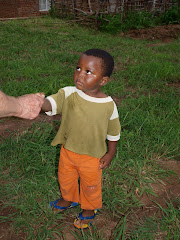
One precious little girl had her sandals on backwards, with no apparent impediment to her ability to move around.  That picture was too me depictive of a country where things were backwards, but whose people were bravely negotiating the shifting circumstances they encountered day to day.

Tuesday, August 11, 2009

Thinking about the uninfected but at risk ...

Wednesday, February 4th 


Gateway Primary School and Gateway High School are private Christian schools in the capital city with which TEAM has had a close association from their beginning and from which a number of TEAM missionaries’ children have graduated.  A fellowship of believers begun by TEAM missionaries continues to meet for worship at the primary school.  The leadership of these schools has always had a keen interest in the spiritual and socio-economic need of the people in the community and nation as a whole, and have engaged in ways to meet this need.  On Wednesday morning, TEAM’s area leader and I met with one of the headmasters to talk about how we might work together to better protect uninfected children in Zimbabwe from contracting the HIV virus.


I was able to present the dynamics of  “Reach4Life”, a program developed by the International Bible Society based in South Africa and directed by a dear friend whom we had known from early days in Zimbabwe.

The Reach4Life program is aimed at the youth of Africa, offering a life-transforming encounter based on the text of the Bible and resulting from a year-long curriculum.  The program’s statistical record show genuine success.  Having recently produced their millionth (New Testament), and after having been embraced globally in a number of applications, they offer a well and comprehensively contained program to churches, schools and organizations that are approved for partnership with them.

Reach 4 Life is a “plug and play” option available to TEAM with a clearly defined approach to HIV/AIDS prevention by means of spiritual life transformation.

We are poised to enter into a partnership with Reach4Life. There seems to be a very real possibility that TEAM will be able to connect with Reach4Life in a strategy that would prove effective in protecting those at risk from the virus but as yet uninfected.