ANY news that indicates progress in the fight against HIV infection is good news.
Thailand has been the testing ground for a new HIV vaccine, or combination of two vaccines already in existence. The world heard today of the results of that test. At first glance, it is very exciting news ... the whole world holds its breath for continued positive indicators.
Under closer scrutiny, there seem to be many variables, especially as it relates to other regions of the world presently in the grip of the pandemic.
You can read more about it on the link listed to the right under "Relevant Web Reports ..."
We continue to watch, pray, and do everything we can in the meantime to reach out to those infected, affected and not yet infected but at risk ...
Friday, September 25, 2009


Monday, September 21, 2009
"An encouraging day ..."
Today is one of those days that contribute to the encouragement factor.
We are reflecting on a $500 gift we just heard about from a church in North Carolina. Also, today, a draft proposal for the Zimbabwe HIV/AIDS initiative has been forwarded for consideration by a gifted professional in Chicago without charge. I've also been in touch with another wonderfully gifted professional from USC who is interested in helping out with one of the most significant aspects of the Zimbabwe strategy; the formulation of a forum of national initiatives. Then a friend sent me a Facebook message to say that he has arranged for an on-going donation to be deposited in our home office account monthly. When I checked the account this morning, I discovered personal contributions that people had quietly made without any indication to us of their having done so ... giving without regard to reward. How gratifying is THAT ... for all concerned?
Words cannot express how special it is when individuals and/or groups of individuals respond to an inner prompting to invest in what our lives are invested in. It brings a warm deep-down understanding that someone else's heart is beating in rhythm with ours ... that we're not alone in the huge endeavor.
There's a fine line between "soliciting funds", and "making a need known."
We are not into soliciting funds, but the need is great!
Should you be moved to participate in a tangible way, please contact me at budwestcoast@shaw.ca and I'll be more than happy to point you in a direction that will allow you to select one of a few carefully accounted for, tax deductible ways to be involved.
Don't you just LOVE it when a day like today comes along?
Saturday, September 19, 2009
"It's a good beginning."
The video clip http://teamworld.org/LEARN/Video_Zimbabwe.aspx (please see the box on the right, under "Zimbabwe report ...") ends with the words, "It's a good beginning."
The clip tells the story of "Tatenda", a young girl who was sent from the hospital to die. "Happiness," another twelve-year old girl took charge of Tatenda and literally reversed the course of her prognosis through nothing more than tender loving care. It is more than significant that "Tatenda", which means "we are thankful" should have been helped by "Happiness." The most significant response in Zimbabwe today is one that is entered into with joyful enthusiasm and motivated by old fashioned loving care and concern
This is a tiny window through which the reality can be seen, where the poor are helping the poor. As this story is multiplied through the sincere efforts of deeply motivated individuals and groups of individuals, real change is taking place.
The good work being facilitated in Zimbabwe by TEAM is being complemented in country by other like minded organizations and national initiatives. We want this good work to grow and expand across the nation. It will take a harmonized. coordinated effort to get it done.
With a "finger on the pulse" and with a locally realized practical response in place we will ensure best results from available people resources and donor funding.
If you feel compelled to have a part or be a part in this challenge, please write to me at budwestcoast@shaw.ca.
Friday, September 18, 2009
It’s all about the compelling motivation …
If you had your ear to the ground around the time of the Kenyan presidential election in 2007, you will have heard of the horrible inter-tribal violence that took place across the country in the aftermath of the election in December of that year.
We were in Kenya six months later where we met and spoke with people who had been impacted in one way or another by the violence.
We stood in the ashes of a burned down church where women and children who had gathered there for safety and protection had been burned alive. We stood and looked down at the mute evidence of those lives … small pieces of clothing with burn marks that showed where the flames that had consumed the rest had ended … the burned remnants of childrens’ shoes … arbitrary house keys lying in the ashes.
Later, as we sat in the boardroom of Daystar University, we heard how a dazed group of pastors from local churches had confessed that they had actually been involved in perpetuating some of the violence.
It was as if they had woken up from a dream, and couldn’t understand what had happened. They had come to say, “Please help us understand why we were killing each other.”
We sat with brilliant scientific researchers from universities in the States who were with us on the trip and listened as they interacted with their Kenyan counterparts about how to respond.
I listened with a pastor’s heart and began to reflect on the fact that while research is valid and even needed, the main thing was being over-looked. The issue is a deeply spiritual one, as far as followers of Christ are concerned. The great commission does not just demand great conviction. It ALSO requires great compassion.
If we’ve never understood, “As the Father has sent me, so send I you,” we need to understand it now in the face of the horrors resulting form the AIDS pandemic across Africa.
In the weeks and months that followed that meeting, I reflected on the decades we had been involved in evangelism and church planting in Zimbabwe. I reflected on how passionate we were when it came to discipling followers of Christ on the theology of conversion, but wondered if we had been diligent enough when it came to the theology of compassion.
I went back to the Book, and was astounded to realize more than I had ever realized before, how much of Christ’s earthly ministry was taken up by reaching out and touching hurting people.
Throughout our career, we have been driven by the necessity of sharing the Gospel message to people who needed to hear it so that they, having embraced it, could take it to others who hadn’t heard it yet. That passion remains.
But now, we feel equally driven by the necessity of demonstrating and teaching the compassion of Christ in a world of people that so desperately need it.
I honestly wonder whether our culture of Christianity has distorted our view of the Christ whom we claim to follow. It’s not enough to say what He said. I’m convinced that his heart is grieved when we don’t do as He did. That too is part of the mandate He left us.
Then, as I looked at the history of the global response to what I refer to as Africa’s predicament, I was equally challenged.
Poor people die in Africa not because of the world’s indifference to their poverty … and the ills that poverty brings … but also because of well intended yet ineffective efforts on the part of well meaning outsiders looking in.
HIV initiatives in Africa are a dime a dozen. Most of these involve the development of a “project” that is then planted in a given location with varying degrees of cultural adaptation and use of local resources.
These have met with varying success, require large amounts of money and rarely survive eventual nationalization of the program with its accompanied tapering of external resource input and accountability.
At best these programs impact one or two of the of the amazingly diffuse number or problems associated with the HIV crisis (orphans, treatment, child led homes, education, prevention etc., etc., etc.).The net result is less than a blip on an incidence curve that is spiraling out of control.
There is, however, one exception in Africa. Uganda was the first African state to report HIV infections of an epidemic proportion. It is also the first nation in Africa to demonstrate not only a slow down in the number of new infections annually, but an actual decrease in the number of HIV infected cases.
It happened slowly, because there was no catalyst to speed up the natural gradual process, but it happened.
Even the Ugandan government openly states that this turn around was due to the involvement of the Church, not one building or one congregation but tens of thousands of believers in multiple congregations, all across the country. It started small with one person here, another person over there saying, “enough is enough, something has to be done!” Individuals started, others gathered around them and eventually whole churches got involved.
The initiatives varied from poor widows impacting child led households in their communities to sophisticated schools for orphans, feeding programs and treatment centers. Some aligned themselves with official government programs exponentially expanding their effectiveness, while others stayed small and focused.
Eventually, many aligned themselves with churches in the West, not only increasing their own effectiveness but impacting the western churches in ways their leaders could only have dreamed of.
The things we witnessed during the time we spent in Zimbabwe earlier this year proved to us that Africa is changing. Zimbabwe is changing. The old “I don’t want to get involved” attitude is being replaced by a desperate desire on the part of poor people to do “something”, “anything” to ease the pain and suffering around them.
African church leaders are coming to their missionary counterparts begging for help and advice. It is into this scenario that we have introduced our HIV/AIDS initiative.
We are not interested in a well-developed program that can be plopped down in the center of Zimbabwe. We want to be a simple, unobtrusive catalyst.
Someone has said, “We can either look at the HIV epidemic as the worst medical disaster to hit the earth since the Black Plague or see it as the greatest opportunity Christ has given His Church to demonstrate His love to the to the disenfranchised and marginalized sectors of global society since Christ Himself walk on this earth.”
A Sample Vignette
There is an elderly widow woman in the Eastern highlands of Zimbabwe who was reaching out to teen led homes in her community with the little she has herself.
Twenty years ago we heard stories of grandparents in Africa having to raise their grandchildren because of parents who had died of AIDS.
Today the situation is far worse. Now, a generation later, those grandmothers have died, many of the grandmothers who were to have replaced them have died from AIDS, the parents have died and the small children are left to themselves, teens and even pre-teens have been saddled with the responsibility of not only caring for themselves but raising their younger siblings as well.
In one small village this elderly widow could no longer sit back and ignore the plight of the teen led homes around her. Beginning with the closest home she committed to visit them at least once a week, bringing food when she could, which was not often.
When she visits these orphan led homes, she teaches the young children how to cook and keep house, gives instructions to the older children among them how to run a home. She models how to plant and care for their small garden, and teaches the youngest among them how to read.
She ends her time with them each visit by reading from the Bible and praying with the children, giving expression to the love of God that causes her to reach out in love. The children have grown to love her and look eagerly forward to her visits.
She added homes to her list until she was visiting five homes every week. Realizing that she had reached her limit, yet driven by the enormous need, she has enlisted ten of her widow friends, teaching them to do as she has done.
Now, through the efforts of a single widow woman 55 homes in this small community are receiving mentoring and a clear picture of Christ’s love.
This is a true story and is just one example, one of many points of light, springing up all over Africa.
Monday, August 31, 2009
HIV/AIDS Southern Africa Trip

Bud and Mandy Jackson are coordinating TEAM's HIV/AIDS initiative in Africa.
In the early part of 2009, they spent a month in Zimbabwe to see TEAM's hands-on involvement in the tribal northeast of the country. Another month was spent in South Africa, seeing what was going on in KwaZulu Natal and up into northern Zululand.
Because a main part of the strategy involves networking and partnering with other HIV/AIDS-related organizations and agencies in North America and Africa, much of the time spent in Africa was dedicated to building the relational groundwork necessary, and beginning to build a framework of cooperation of intention with wonderful people of like mind and shared purpose.
You are invited to share Bud and Mandy's experiences through the medium of this blog, as you join them in their travels and gain an understanding of where their hearts are in the face of Africa's struggle with the HIV/AIDS pandemic.
Sunday, August 30, 2009
Anticipation ...
Friday, January 2nd (Frankfurt, Germany)
During a twelve-hour lay-over in the stark interior of Frankfurt’s international airport, we had plenty of time to give thought to the transition we had entered into as we left the pristine and abundant conditions of the Pacific Northwest coast of Canada and turned our attention to Zimbabwe, a nation in the tenacious grip of serious inflation, severe poverty and unemployment, and struggling with the devastating impact of diseases like malaria, AIDS and cholera.
Mandy wrote, “My return to Zimbabwe after a seven-year absence was a spiritual, mental and emotional hurdle for me, but I was more than ready to face it. During the intervening years, I’d been diagnosed with and received treatment for “post traumatic stress syndrome” that was a result of a series of stressful incidents I’d encountered during our last term of service there.
As we waited at Frankfurt airport, I again praised the Lord for the deep sense of purpose and excitement I felt anticipating our return to Africa, knowing that this was His appointed mission and time for us. I also thanked Him for the sense of peace He’d given me, despite my misgivings about Africa’s unpredictability.”
Taking care of last minute correspondence before landing back in Africa, I wrote to a friend to say, “Well, here we are waiting in yet another airport departure lounge...
Waiting for another plane to take us to another destination.
We're about to board our flight to Jo'burg via Frankfurt, then on to Harare.
This has been a tough trip to prepare for. There are so many unknown quantities. I never thought I'd have such a mixture of emotions about returning to my homeland. We have a case packed with a few personal items, and extra bags crammed full of dried foods, nuts, nutritional bars and second hand clothes.
At the same time, we are excited ... and looking forward to the challenges that will face us. We have a supply of anti-malaria tablets, have invested in a UV water purifier, bought some H2O purification tabs, have a collapsible water bottle stashed away in our carry-on, and are good to go.”
Saturday, August 29, 2009
Arrival ...
Saturday, January 3rd. 2009

The first wave of nostalgia hit me as we landed at Harare International airport. Although not as international as it once was, it was nostalgic nonetheless to walk off the aircraft and into the main concourse late on the Saturday night of our arrival from Johannesburg.
Many of the bulbs that would normally bring brilliant light to the comings and goings of travelers who ventured there were not functioning. As eyes adjusted to the gloom, we noticed a group of civilian-dressed people sitting behind a two-countered desk, bantering and visiting together. Thinking this was a preliminary step to the formalities of immigration and customs, we made our way there. After paying for entrance visas, a reminder of altered status from resident to visitor, we continued on our way.
Without any further ado, we collected our luggage and were swept up by a couple of porters who led us directly through the “nothing to declare” route into the public receiving area where we saw friends who had come to meet us.
The second wave of nostalgia arrived as we stepped out into the balmy Zimbabwean night. After loading our collective personal and additional luggage, we piled into a double cab pick up truck and made our way out into the darkness.
Mandy wrote, “Personally, I would have preferred to arrive during daylight hours so that I could see my surroundings clearly. Arriving at night unnerved me, and I found myself suspicious of the dark that hovered beyond the reach of our truck headlights and the occasional functioning street light.
I kept reminding myself ‘He who has led you hitherto will lead you all the journey through’, and I was thankful that my Father knew exactly where I was and was watching over me. They say that ‘ignorance is fear’, but in my case a consistent tracking of in-depth news from my earthly homeland had enlightened me enough to know what dangers potentially lay beyond the ‘safety’ of our vehicle!
Forty-some years of memories prompted by such familiar surroundings, fragrances, atmosphere, and balmy night air, flooded my mind and emotions as we traveled well known roads to our mission’s headquarters on the opposite side of the city.
I noticed the ‘new’ procedure of negotiating intersections where robots (traffic lights) were either non-functional or partially functional, but always confusing. Even when the lights were present and working, they could not be relied upon. Sometimes, only the ‘caution’ light would be working from one approach, and only the ‘go’ light working from the opposite approach. At other times, the lights on all four corners (if there and working) seemed to have a mind of their own. Worse case scenario was evident at a few places where all four lights were green at the same time. We soon learned the best way to navigate across intersections was to keep one eye on robots directing the other approaches (wherever possible), and the other on any vehicles coming from the sides! . As Bud said one day, in the course of a trip across town, ‘The thing that dictates the flow of traffic in Zimbabwe these days is personality!’ It seemed the more aggressive drivers had no problem making progress as they nosed their way into the fray and emerged on the other side without a scratch. Thankfully, Kiersten, our seasoned driver, knew what she was doing that night!”
The third wave of nostalgia washed over me as we traveled. With head hanging out of the left rear window, I inhaled the familiar fragrances wafting on the night air, and was transported back to the socio-linguistic groove that welcomed me as a long lost friend.
Mandy had a slightly different reaction … “I was immensely relieved to enter the gated and walled compound of our destination, and to find that the electricity was working. Soon I found myself unwinding as the tension released it’s grip on my body. A cup of herbal tea in hand I sat up in bed under the mosquito net while an infusion of peace and ‘rightness’ in my world flooded in. I slept soundly.”
So, after a forty-hour trip halfway around the world, we slept well for what remained of the night. The whine of mosquitoes venturing back and forth on the outer surface of the netting securely tucked around us was a final welcome as we drifted off to sleep.
Friday, August 28, 2009
Tshipise, here we come!
Sunday, January 4th. 2009
 We were up early the next morning, preparing to hit the road south. Once the ladies had returned from a last minute excursion in the direction of the shops, we embarked on the all-day journey that would take us toward the border with South Africa and a cozy night at the Lion and Elephant Hotel on the banks of the dry sand of the Bubi River.
Mandy’s excursion in search of supplies for the trip South was an interesting experience. “Going shopping early the next morning to buy some provisions for our journey, I felt like a visitor to a once familiar place. So much was still the same to me, and yet so much had changed. There was a feeling of ‘disconnect’ between what I saw and what I knew to be reality. This theme continued to play throughout our month’s stay.
 Before we’d passed the outskirts of Harare I noticed the first of very many abandoned vehicle carcasses in various stages of deterioration. This alerted me to the reality of the heightened risk one undertakes when driving Zimbabwe’s roads. The combination of excessive speed, carelessness, awful road conditions and the unpredictability of “the other” driver calls for skillful defensive driving and a total dependency on the Lord’s hand of protection.”
The day was a wonderful adventure, given the level of excitement most of the occupants of the Toyota van shared. This, in spite of having to negotiate numerous Police road-blocks and menacing potholes, and some road-crossing cattle along the way. Providence planned the timing of arrival at our destination in a way that allowed for a leisurely stroll along the riverbed. Late evening bird song accompanied our intent investigation of signs of the wild as we walked, turning just in the nick of time to make it back to the dim distant lights that beckoned from farther away than we thought.
Thursday, August 27, 2009
Lion and Elephant Motel (on the Bubi) and on to the border crossing …
Monday, January 5th
Mandy had an opportunity to visit with a woman in distress that morning at breakfast.
Mandy had an opportunity to visit with a woman in distress that morning at breakfast.
 "During breakfast, I was alerted to an elderly lady sitting on her own on the other side of the dining room. After hearing about the sad circumstances she was facing, I felt drawn to go over to her to chat with and pray for her. She was a recent widow. She had traveled to the border with her son the day before to enter South Africa in order to see her sister who had only a short time left to live. She’d been denied passage through the border and after finding a rideback to the motel, had parted from her son who’d continued on. Now she was waiting for a friend from her hometown to come and get her. The toll of the stress of the past nine years showed on her face and in her eyes. She’d lost the family farm to the government, she’d lost her husband, she was living as frugally as she could to make her limited resources stretch. She was about to lose her sister, and here she was in this moment, all alone. I was so glad that I could encourage her to trust in The One who would never leave her alone, nor forsake her."
After a lovely breakfast in the open-sided dining area on the riverbank, we loaded the vehicle and made our way toward Beit Bridge and the experience commonly referred to as, “crossing the border.”
 It was just as well that we had steeled ourselves for the lengthy stand-still interludes, under the wonderfully hot Africa sun, that interspersed occasional tentative footsteps in the direction of the air-conditioned interior of the Customs and Immigration building. Shuffling our way in the queue through the necessary formalities at the border gave me two great opportunities! The first: to feel and absorb the heat of the African sun on my skin again, and the second: to engage in conversation with folk around us.
Mandy had an interesting conversation with a young African man in his mid-twenties. She writes, "He was on his way to Messina in his ‘bakkie’ to shop for clients living in Zimbabwe. During at least ninety minutes of conversation, he opened window for me to see life from his perspective and as my heart ached for him, I was amazed at his ability to laugh and keep going despite his incredibly stressful challenges. Challenges such as:
* having to close down his two general dealers stores due to: the shortage of fuel, the empty shelves at his wholesaler suppliers, the devastating lack of buying power of his clientele, the unpredictability of government edicts, the unreliability of workers who either steal because they’re so hungry and desperate or are absent more often than not due to illness.
* having to move to the border town, away from his wife and children in order to try to make a living any way he can.
* being the sole provider for his wife and children, and for their combined extended families at his rural home.
* having to keep applying and paying for a valid visa to enter South Africa that only lasts for a couple of months at a time.
* Having to pay for the school fees, uniforms and books of his younger siblings despite the fact that most of the government school teachers had stopped reporting for work due to the non-payment of their salaries for months on end."
After finally breaking free from officialdom, we made our way into Messina. The welcoming embrace of the little town, at one time a perennial reminder to our family of our arrival for holidays in South Africa, was different to what we recalled. Once a lazy border town, Messina was now a crowded bustling boom-town, populated for the most part by Zimbabweans who had managed to make it to the place where they could purchase supplies of the unobtainable basics intended for the gauntlet that would transport them back to waiting families and businesses back home.
 Mandy describes her re-entry into the land of her birth this way; “As we approached Messina, we were confronted by a huge billboard that boldly stated, ‘Zimbabwe is starving for Democracy,’ with the picture of a child entrapped inside the rib cage of an animal carcass. How poignant, how real, how tragic, how humanly helpless and hopeless the message is. It hit me hard.’
After purchasing a few basic supplies, we embarked on the final leg of the journey that would take us to Tshipise, a quiet oasis of green dotted here and there with shaded thatched chalets and the warm waters of the mineral pools that are its central attraction. It was here that we were to meet up with TEAM-mates who would gather from Zimbabwe and Mozambique. Later in the week, the area leader and his wife from South Africa joined us for the time that had been set aside to talk about the challenge of a proactive response to HIV/AIDS in the ministry areas represented.
Wednesday, August 26, 2009
Annual Conference ...
Tuesday – Friday, January 6th – 9th
The joint TEAM family enjoyed a wonderful time of rich fellowship, good food and not a little bit of fun in the week that followed; all of which was a wonderful relief, if not release, for co-workers who had been standing firm in the face of intensely difficult ministry circumstances in the days, weeks and months prior.

A troop of vervet monkeys visited us every day, the dominant male acting for all the world like a feudal baron while his wives released their new-born babies within the safety of the setting to learn the rudiments of walking on unsteady legs as they traveled across the landscape of their new natural world on tip-toes of touch, smell and taste.
Toward the end of the week, the conference broached the pressing issue of widows and orphans and the ever-looming presence of the HIV/AIDS crisis. We had left North America with a
clear sense of providential direction to our thinking. The team we had interacted with in Canada and the US had seen clear possibilities emerge that revolved around TEAM’s unique strengths and degree of credibility in the ministry areas where we serve. We arrived in Southern Africa committed to listening, observing and seeking to learn from the perspective of workers on the front line. In short, we had embarked on a fact-finding trip.
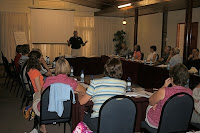
It was toward the end of the week of conference that we received the first clear indication that the thinking and reflecting of our co-workers on the front line of the battle had been following a parallel path to ours. With clear vision on the part of the area leaders of both Zimbabwe/Mozambique and South Africa, and genuine interest on the part of those attending, it began to become clear that the pandemic had already brought all of the key players to a point of meaningful action.
The annual conference agreed to initiate the formation of an HIV/AIDS task force as a first step in the direction of an organized intentional step toward compassionate ministry.
Mandy too, found conference to be a refreshing experience. "It was such therapy for me to be in the midst of my fellow co-workers again. I loved every minute of the opportunities I had to hear about their ministries, to catch up on their lives, and to sense their challenges both personally and in ministry. God gave me moments of one-on-one time with several ladies and it was wonderful to be able to connect at a deep level, praying and bearing each other’s burdens."
Tuesday, August 25, 2009
Heading North ...
Saturday, January 10th
 At the conclusion of that week, Mandy and I joined six others in a heavily laden van for the return trip up-country. With every spare space in the van taken up with accompanying luggage and with a heavily laden trailer in tow, we made our happy way back across the Limpopo River and northwards into Zimbabwe. It seems so simple and straightforward in the telling … but it wasn’t. Arrival and inch-by-inch progress from the southern to northern banks of the Limpopo River is for the traveler like a sticky, clinging swamp to a cross-country runner.
Police road-blocks were a further impediment to progress, with an order from a uniformed officer at one resulting in our having to detour to the local Police base to undertake repair of the lights on the trailer we were towing. With a bulb taken from its intended place at the tail of the trailer, and with a length of wire scrounged from the police camp, we fashioned a crude test light and set about trying to make sense of the tangle of wires intended to carry current from plug to bulbs.
Once clearance was eventually given for us to proceed, we had to undertake the last 175 kilometers (109 miles) of our trip in the dark.
Driving after dark on Zimbabwean roads is very dangerous for relatively small vehicles. Large transport lorries tend to travel at this time, paying little attention to potholes that do significant damage to smaller vehicles, sometimes with fatal results. The metal carnage strewn every few kilometers along the sides of the road had been a persistently graphic reminder of this. When driving slowly, it is possible even after dark to swerve around the more menacing potholes. That is, unless the blazing lights and considerable bulk of a speeding on-coming lorry, blind the driver’s vision and force one’s vehicles to the edge of the opposing lane.
Shortly after having embarked on this last leg of the trip, the atmosphere inside the van was shattered by a load bang, and accompanying sudden jolt, followed by violent swerving as the driver fought courageously to keep the vehicle and trailer under control. Once our ensemble had come to a standstill, both vehicle and trailer were as far off the road as the narrow verge would allow. With the wheels on one side sitting on the surface of the road and the wheels of the other on the considerably eroded soil of the road verge, we disembarked to assess the damage. Miraculously, our driver had managed to evade the pothole with the front wheel. Had he not managed to do this we would not be present to tell the tale. As it was, the rear tyre and rim of the van and tyre and rim of the trailer were destroyed.
The minimal availability of equipment was made more menacing by the dangerous angle of the vehicle looming over us as we worked to correct the situation.
 As the women prayed, the men worked. At one point, a jack slipped just after one of our number had removed a vital part of his anatomy from underneath the loaded vehicle. Eventually, though, we pulled back onto the dangerously pockmarked road to continue on our way. What should have taken an hour and a half took us over four hours as our intrepid driver nursed the vehicle and trailer homeward, finally arriving at our destination at 11:00 that night. With a 7:00AM departure that morning, it had turned out to be a very long day.
Mandy recalls, “As we prayed in the van, it was incredibly comforting to know that many loved ones around the world were covering us and our trip in prayer. There’s no doubt that God had His hand on our vehicle and fellow travelers that day.”
Monday, August 24, 2009
Celebration Sunday ...
Sunday, January 11th

The next morning came with a rush and, being Sunday, we found ourselves on the way to a celebration service hosted by the Evangelical Church of Zimbabwe. The purpose of the exercise was to give opportunity to the twelve hundred or so people who had gathered to rejoice over the reconciliation that had taken place between the church and the mission that had birthed it.
The organizers had given careful thought and done a great deal of work in preparation for the occasion. A large bowser of clean water, standing near a large open-sided white tent, offered mute evidence of the presence of cholera in the country.
The atmosphere in the tent as we arrived was less mute, but was just as loud in profound evidence of a heightened level of excitement and anticipation.
Words cannot describe the joy of that morning and lunch hour that followed. No cultural or historical barrier could come near to preventing the outpouring of love and joy that was expressed and received by all the parties in attendance. That day, which was without doubt one of the highlights of the whole two months, was made even more special in as much as Wilf Strom … now retired and living in Canada … was there as guest of honour for the occasion. Wilf and his wife had arrived in the country to serve as missionaries some fifty years previous. Wilf had eventually held the position of area leader during a very challenging time. As Field Chairman, he had led the then missionary band through the stormy relational and organizational waters of post-independence tensions that crept into the relationship of mission and church. This he had done with dignity and Godly grace. Now, he was present to witness the full-circle evidence of the working of that Godly grace in the lives of all involved.
Mandy commented on the day; "The timing of this amazing celebration; the opportunity to be re-united with many dear friends; the emotion of the occasion, all worked together to open the floodgates of long dammed up emotion for me. It was difficult to take pictures of the event through the flowing tears! Praise the Lord for His goodness and graciousness!"

Sunday, August 23, 2009
A local Interlude ...
Tuesday, January 13th
After a day of rest, and a lovely dinner at the home of one of the missionaries, Tuesday’s dawn ushered us into a round of visiting key installations and individuals around the city. We visited Harare Theological College and saw the good work of training being accomplished there.

Mandy wrote, "During my time with them I was given yet another window from another perspective to look through. My heart ached again as I learned of the incredibly stressful challenges they live with:
* the deep concern for their daughter, a young mother, whose pulse is alarmingly slow and who needed to travel to South Africa to have a pace maker inserted.
* the torrid times of having their farm invaded or interfered with.
* dealing with a workforce who are unable to source their own food supplies due to the empty shelves in the supermarkets; workers who are HIV positive and increasingly unable to put in a full day’s work; workers who need time off on a regular basis to bury family members who have succumbed to the ravages of Aids or any one of a number of diseases that over-power their weakened or non existent immune systems; workers who need medical attention from barely functioning clinics or hospitals that have no medical supplies.
* the pleas for expertise and practical help from those who have taken and occupied large tracts of your land with the full support of the judicial system and law makers.
* struggling to keep old and tired farm machinery and vehicles functioning despite the outrageous cost of spare parts IF they can be found.
* remaining viable when the infrastructure of the country is crumbling: bad roads, unreliable telephone service, electricity cuts, spiraling inflation, worthless bank notes, crime and corruption at every level.
It was my joy to observe their rock solid faith and trust in the Lord despite everything, and to pray with and for them. I was given the great privilege of visiting others in the district living under the same circumstances, hearing their hearts, and praying with them too."
Saturday, August 22, 2009
Excursion to Kapfundi ...
Wednesday, January 14th
 A small clinic, struggling to operate without running water and adequate amounts of necessary drugs and materials represented the only evidence of resuscitation. The congregation of people who gathered for an impromptu four-hour long service was the only evidence of what had survived the passage of the years and socio-economic ravages afflicting the nation in the previous three decades.
Early Wednesday morning, a contingent of Evangelical Church leaders joined our group to travel in a convoy of two vehicles out past Karoi to the site of an old mission station, now a scattered ruin of debilitated and destroyed buildings, where a school was begun, a Bible college established, a clinic built … and a church given birth.
 A small clinic, struggling to operate without running water and adequate amounts of necessary drugs and materials represented the only evidence of resuscitation. The congregation of people who gathered for an impromptu four-hour long service was the only evidence of what had survived the passage of the years and socio-economic ravages afflicting the nation in the previous three decades.
Returning to the mission station site brought back a flood of memories for those of us in our group who had lived there.
This was particularly true for Wilf Strom, a veteran missionary traveling with us, who saw the remains of the house he and his family had lived in and looked for the spot where he and his wife had laid one of their infant children to rest.
Excursion to Mt Darwin District ...
Thursday, January 15th
The trip out into the Mt Darwin district the following day was a particularly poignant one for me, as I had lived in the region for a special part of my childhood, then lived and worked there as a married man with a young wife and two small children.
Even before we had found opportunity to sit and speak with the people in their villages, we noticed profound evidence of decay. The extremes we had observed the day before in the Urungwe tribal area were equally apparent as we traveled into Chief Chiweshe’s realm. Nation-wide scarcity of something as basic as bicycle inner tubes and patches and compound glue was evident by the conspicuous absence of bicycles, perennially abundant modes of haulage and transportation that had been such a common fixture in previous years.

In spite of abundant rains, the crops were very poor if evident at all. Previously available small subsidized packets of registered and treated maize seed had been absent for some time, as was the case with Compound ‘D’ fertilizer, traditionally applied at planting and, later, the fondly referred to “A.N.” (ammonium nitrate) widely used as a top dressing for the established plants.
Once plentiful chickens, goats and cattle were very few and far between. Domesticated guinea fowl had become a common addition to the few scrawny chickens that still scratched around the villages. At one point, we encountered a pair of forlorn looking muscovy ducks wandering aimlessly along the dirt road.
On the way to Karanda Hospital, we called in at what had been Chironga mission station. The now government-controlled school classrooms that the missionaries had built still stood there, as did the structure that had once housed the teacher training school. Many of the missionary houses remained, lived in by government teachers and their families.
The burial site of a missionary couple’s infant boy, and another’s grown son, was still there where I remembered it to be; wrapped in the verdant embrace of the rainy season, tucked in behind the protective bulk of a granite outcrop.
After having reached our destination, we established our temporary residence at Karanda Hospital’s lovely guesthouse. Personal nostalgia continued for me as I made my way toward the house where my family and I had lived when we first arrived there as missionaries twenty eight years previously.
I further celebrated my return just before dark, as I made my way to the village of the aged Baba Josiah. He had once been the tractor driver at the hospital station, and kind friend of our small children. I had met his son, Solomon one afternoon as I hunted for guinea fowl along the Ruya river. That was the beginning of a friendship that had stood the test of time and shifting circumstances.

I’ll take the liberty of digressing here, to tell you the story.
I first saw Solomon sitting in a dry sandy portion of the riverbed that afternoon. He was sitting on a large granite boulder worn smooth by the unrelenting flow of water in that cycle in the life of the river each year when the river ran full and strong. Customary greetings were exchanged, and I sat with Solomon on that rock as we heard of one another’s families, exchanged thoughts on local issues and began to gain a measure each of the other.
As the afternoon turned to evening, we negotiated our way out of the river bed through the wafted aroma of wild herbs that grew on the bank of the river, and up in the direction of his village. At one point, once we were in the vicinity of the community fields of maize stubble, we stepped off the path to make our way through the dry golden left-overs of the year’s crop to where we found a ripe watermelon on the vine. Making ourselves comfortable in the dry maize litter, we shared that watermelon and began to find out more about one another. It was there, and in the ensuing days that Solomon’s personal story emerged.
At the age of twelve, he had left home early one morning as he had done every other morning of the school year. Bare foot and dressed in khaki shirt and shorts he joined his friends to walk, rulers and pencils in hand, to the school he attended. That day, the whole school was visited by guerilla combatants, every child abducted and taken on a force march that lasted many days. The column made their way north toward the Zambezi Valley and the river that gave it its name. In the course of the journey, a number of children died of thirst and exposure. On one occasion, some were killed in the cross fire of a running skirmish between the guerillas and Rhodesian government security forces. Solomon told me of being so thirsty as he came across some stagnant mud in the bottom of a stream bed, that he scooped the mud into his hands to suck the moisture out of it.
Eventually he and the others who had survived made their way across the Zambezi with the aid of wooden dug-out canoes. He ended up in Tanzania, where he was indoctrinated and trained as a medic combatant.
Just before being sent into the combat war theatre, he narrowly missed being numbered among the hundreds of dead combatants killed in the famous cross-border raid by Rhodesian security forces on Chimoio Camp, in Mozambique. Eventually, after having infiltrated with a small group of fighters into the country still known then as Rhodesia, he was wounded and left for dead by Rhodesian soldiers.
After hiding out in an ant bear hole, he made his way under the cover of darkness into a nearby village where he recovered and masqueraded as a son of the family living there. Eventually, after the war ended, he made his way back to his traditional home area only to find his family’s village razed to the ground. Sitting forlornly next to the path that led past his former village, he was greeted by a person passing by. When that person heard who Solomon was, and saw the devastation evident in his sad discovery, the passer by told Solomon that his family had moved. He then told Solomon where to find the village, which he did late that evening when he was reunited, now a young adult, with his parents and siblings.
Solomon and I met a couple of years after this, by which time he had a wife and small child. I met them, as well as the rest of his family that evening as we made our way in the light of the moon from the maize field toward his village. We ended that day, gathered around a fire, where we roasted peanuts and shared them as accompaniment to stories told by firelight in the natural bonding process that took place.
That evening was repeated many times, as were hunting excursion along the river, and walks back up to the village. As our conversations continued too, they began to take on deeper meaning as Solomon discovered the dawning realization that he had been spared for a purpose. Gradually, he began to form a natural connection between his experiences of deliverance and what we spoke of in terms of a God who knows and loves each individual, with an eternal purpose in mind for mankind. The time came eventually, when he invited me into his hut and there, seated together with his young wife and infant son, he prayed for the first time to that God in the name of His Son, not through an ancestral spirit medium, and discovered the dynamic of eternal life and entrance into the abundant life that Jesus gives.
In the ensuing years, the rest of the extended family followed suit, as did the children who were added to the clan. Solomon’s younger brother, Edison, had been a school boy when we lived and worked in the area. Every weekend, he helped me with yard work and the caring of our children’s guinea pigs and rabbits and the flock of chickens that kept us well supplied with eggs. My family formed a bond with Edison too, that had remained.
Now, decades after having last seen the family, I was returning, not knowing what I would find.

I saw Baba Josiah from a distance as I disembarked from the vehicle and made my way toward the cluster of huts that represented the family home. He had lost an eye and was almost completely blind in the other. Emaciated by hunger and the ravages of age, he peered at me, approaching him in the late afternoon light. My greeting, which went along the lines of, “A! A! Muchiriupenyu sekuru?!” … “You’re still alive, Uncle?!” was greeting with silence as he tried to make out who it was who had approached him. Then, with dawning realization brightening up his face, he asked, “Ndimi vaJekisoni?!” … “Are you Jackson?!”.
In the ensuing conversation, I learned that his wife had passed away some years previous. He took me a few steps from his hut to stand next to her grave site situated in his filed of struggling maize. He explained that her wish had been that she be buried close to the village so as to be “near her children.”
Later, I walked with Baba Josiah across a small valley to Solomon’s cluster of huts. There, Baba Josiah summoned a young boy to run to the field where Solomon and his wife were working, with the word that a visitor had arrived.
A few minutes later, Solomon walked into the village, followed by his wife. She was carrying some wild vines which she had planned to prepare for the family’s evening meal. Solomon recognized me immediately and there followed a wonderful reunion. In the course of the conversation that followed, I heard that there was very little growing in the fields that year. Even the previously ever present tomato and onion plants were non-existent. The family’s flock of chickens had all succumbed to a disease that had swept through the area. Only one cow remained in the cattle kraal. The family had no food.
In the gathering gloom, we made our way back to the vehicle, collecting other members of his family along the way. I gave each family a food pack containing some mealie meal, a bottle of cooking oil, dried fish, salt and sugar.
Later, after having returned to his village I sat and visited with Solomon and heard his wife breaking into the food pack in preparation for the first real meal they had had for some time. Then I was invited and humbled to share in the relative feast that followed. Some things never die, like true friendship, genuine camaraderie, and the fundamental generosity of the Shona people. Solomon’s little girl, the youngest of five, ate with relish. She sucked the juice of the fish dish off each finger, crawled onto the chair next to her father and promptly fell asleep.


Subscribe to:
Posts (Atom)